
AutoMobility LA 2025 recap

Updated: Nov 24, 2025
AutoMobility LA 2025 marked a significant turning point for the industry. For years, electrification, autonomy, intelligence, and design have developed separately. This event made it very clear that these distinct avenues are no longer developing in parallel, but are now rapidly coming together into one unified ecosystem, a present reality, not a future promise.
Every unveiling, every keynote, every technical exchange pointed toward one idea:
The future of mobility is no longer a prediction. It is an operating system already running.
Marianne Johnson of Cox Automotive captured it perfectly: "AI is not a feature we are preparing for. It is the infrastructure that will power the next decade of automotive."
Walking the floor and then hearing from the leaders behind the technology created a powerful contrast. The vehicles showed what is coming. The sessions revealed why it is happening and who is building it.
Below is a complete breakdown of the vehicles, insights, breakthroughs, and themes that defined the day.
THE REVEALS
KIA
Kia Telluride and Telluride X Line

Kia introduced the next generation Telluride with a clean, functional redesign and meaningful upgrades to capability and efficiency. The SUV grows slightly in size with a longer wheelbase and more upscale proportions. Inside, a panoramic digital display and improved materials give the cabin a more premium feel.
The key update is the available 329 horsepower turbo hybrid powertrain with an estimated 35 MPG combined and up to 600 miles of range. Off road fans still get the X Pro variant with AWD, an electronic limited slip differential and all terrain tires.
Kia did not position Telluride as an EV nor discuss electrification plans for this model. The focus remained on refinement, performance and expanding the hybrid offering.
VOLKSWAGEN
The Restored Bus for a Family Affected by the Wildfire

One of the most emotional unveilings came from Volkswagen with the restored 1977 Type 2 microbus known as Azul. The bus survived the January 2025 Palisades Fire and was rebuilt as a tribute to both its owners and the brand’s heritage.
Displayed beside the ID Buzz, Azul served as a reminder of why automotive culture matters. Mobility is functional, but it is also deeply personal. Volkswagen captured that sentiment perfectly.
HYUNDAI AND GENESIS
The Crater Concept

Hyundai unveiled the Crater Concept, a rugged EV study previewing the future of its XRT sub brand. The design is aggressive and purpose built. Short overhangs, 33 inch all terrain tires, a reinforced roof structure and integrated lighting signal a vehicle intended for serious off road environments.
Hyundai identified it as an electric concept with all wheel drive and locking differentials but did not confirm powertrain specifications. The Crater’s role is clear. It is a design and capability statement that hints at where Hyundai wants to push its adventure lineup next.
LUCID
Lucid Engineering Showcase
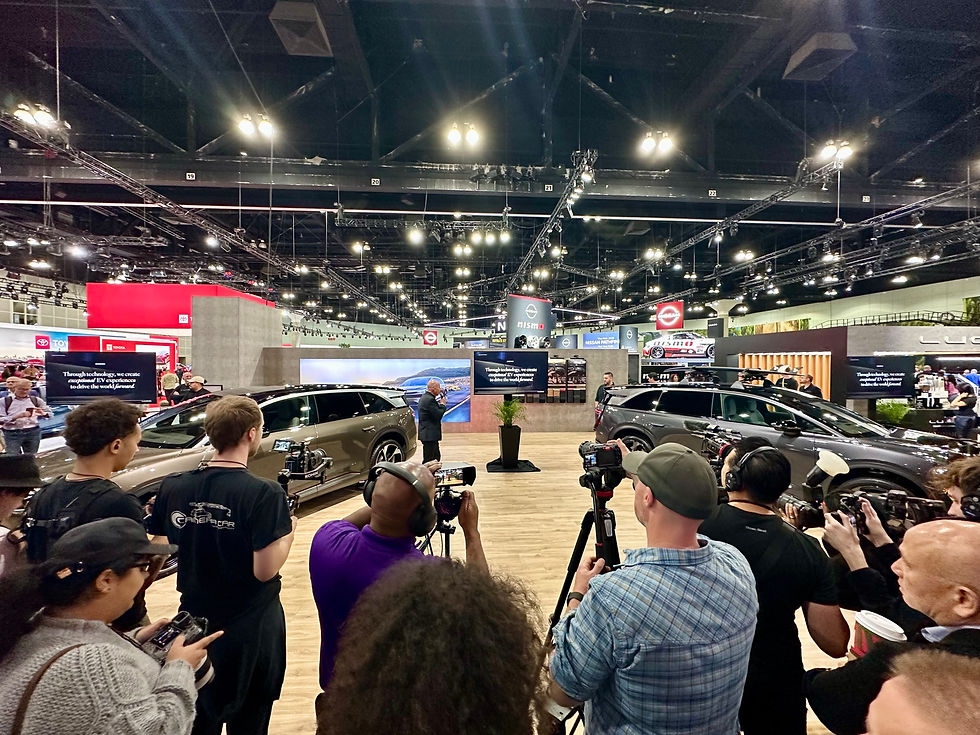
Lucid introduced the Gravity Touring, a more accessible version of its flagship electric SUV that still carries the brand’s signature performance and range. The Touring model uses an 89 kilowatt hour battery with an estimated 337 miles of range and a dual motor all wheel drive system producing 560 horsepower. It reaches 60 miles per hour in about four seconds and can recover roughly 200 miles of range in about 15 minutes on a high speed DC fast charger.
Inside, the Touring keeps the same Clearview Cockpit design language and offers both five and seven seat layouts. It is positioned as a practical entry point into Lucid’s SUV lineup without sacrificing the refinement or technology the brand is known for.
THE SESSIONS
AI is Now: How Artificial Intelligence is Transforming Automotive
Featuring Marianne Johnson, EVP and Chief Product Officer, and David Foutz, VP Enterprise Client Management

Cox Automotive opened the session with a clear message. AI is no longer a feature. It is the foundation the automotive industry will operate on moving forward.
Marianne Johnson set the tone immediately, noting that AI is something she works with “every day, all day,” and showing how agent based systems are collapsing multi day workflows into minutes. Her example was simple but powerful. A process that once took up to two days now takes less than 30 minutes. “We built the first version in four days” she said, underscoring the speed of development and deployment.
David Foutz expanded the scope to the customer journey. Inventory management, pricing, service, retail and financing are all becoming AI coordinated experiences. His core point was that automotive competitiveness now depends on speed, and AI is the only technology capable of delivering fast and high quality decisions at scale.
One quote captured the shift perfectly: “Agent systems do not just give information. They learn your goals, make decisions and act on your behalf.”
The duo also emphasized the rise of answer based search and the need for Answer Engine Optimization so dealership and OEM content is readable by AI systems across the ecosystem.
Their closing line summarized the session:“AI is not something we’re preparing for. AI is now, and it is already reshaping every part of automotive.”
Short, direct and highly pragmatic, Cox Automotive made it clear that AI is no longer coming. It is already running the industry.
The Future of Air and Sea
Featuring Ken Karklin, CEO of Pivotal
Mitch Lee, Co Founder and CEO of Arc Boats
Moderated by Alan Ohnsman, Forbes Senior Editor

This was one of the most forward looking discussions of the day. Alan Ohnsman positioned it as a conversation about what happens when mobility evolves beyond roads entirely. Both speakers represented companies already proving what many still think is theoretical.
Alan opened by asking where the next frontier of transportation will emerge. Both leaders agreed that the next decade expands mobility into new physical layers. Air and water.
Ken Karklin outlined Pivotal’s vision for personal electric flight. He made it clear that the goal is not spectacle but safety, repeatability, and real world adoption. His strongest line captured the company’s core mission. “Flight has always been the ultimate unlock for human movement. Electrification finally makes it scalable, safe, and accessible.”
He emphasized that personal flight will only succeed if it becomes as predictable as a household appliance. Reliability and trust come first, and infrastructure and training follow. The path is methodical, not cinematic.
Mitch Lee brought a similar perspective from the marine side. Arc Boats approaches electrification as an advantage, not a sacrifice. He summarized the shift simply. “Electric is not a compromise on the water. It is a better product in every way.”
He walked through instant torque, simplicity, silence, and the massive design improvements unlocked when combustion is removed from the equation. Electric marine platforms do not retrofit old ideas. They enable entirely new ones.
Both speakers aligned on a single theme. Mobility’s future is multi-layered. Roads, air, and water working together. Clean. Electric. Software defined. Alan summed up by saying: “The question is no longer if air and marine electrification will scale. The question is how fast the ecosystem can catch up to the companies already building it.”
A powerful and insightful session that painted a clear picture of what comes after autonomy and electrification on land.
Are We There Yet? A State of Play on Autonomous Vehicles
Moderated by Katelyn Magney-Miller at PAVE
Featuring John Parks, CEO of Flexdrive
Michael White, Chief Product Officer at Zoox
Brian Bautsch, Director of Safety Strategy at American Honda Motor Co.
Lauren Harper, Chief of Staff at Kodiak Robotics

This was one of the most anticipated conversations of the day. PAVE brought together leaders from robotaxis, autonomous trucking, fleet operations, and OEM safety. The goal was not to speculate but to clarify where autonomy actually stands as 2025 closes.
Katelyn opened by acknowledging the excitement that surrounded autonomy at the start of the year and set the tone with a simple question. Are we closer to mainstream deployment than people think?
Michael White started with a clear update from Zoox. The company is advancing its purpose built robotaxi platform and scaling real world rides. He highlighted a major milestone. Zoox has now begun taking riders off its waitlist and opening up public service in San Francisco. He summarized their vision with a strong line. “It is not just about mobility. It is about giving people time back and letting the vehicle become whatever they need it to be.”
John Parks talked about how autonomy transforms the ride hailing model itself. With Flexdrive supplying vehicles for the Lyft platform, he emphasized how removing the driver changes the entire logistics layer. “When you eliminate the matching step, you unlock speed, utilization, and reliability at a scale the current system cannot reach.”
He pointed out that the path mirrors how ride share adoption grew. What starts as novelty becomes normal once people experience it.
Lauren Harper delivered one of the strongest updates of the session. Autonomous trucking is no longer theoretical. It is operating. Kodiak now has a customer running a fleet of autonomous trucks in the Permian Basin, one of the most demanding environments in the country. She also explained how AI advances have unlocked higher levels of reasoning on the road.
"It is not just object detection anymore. The system can understand the scene and predict the safest path forward.”
She emphasized both opportunity and responsibility. “One bad actor can set the industry back. But one improvement can make every truck in the fleet safer overnight.”
Brian Bautsch closed with the broader safety and regulatory perspective. Honda’s position is clear. The fastest path to widespread adoption is a consistent national framework that avoids state by state fragmentation. He pointed to their Level 3 Honda Legend in Japan as evidence of what is possible. Zero crashes when activated. “Our goal is simple. Get life changing safety technology into as many hands as possible.”
The panel ended with a shared outlook. Autonomy is not waiting for a single breakthrough. It is progressing through real deployments, stronger safety cases, and growing public exposure. Katelyn summarized the feeling in the room.
“Once people experience a true autonomous ride, adoption accelerates fast. We have already seen that story before.”
A balanced and honest session that clarified where autonomy stands today and where it is heading next.
Automobility LA made one thing clear. The industry is no longer debating the future of mobility. It is building it in real time. The unveils showed how fast electric design, performance, and identity are evolving. The sessions proved that autonomy, air mobility, marine electrification, and advanced safety are not abstract ideas but systems already scaling, refining, and generating real world results. From purpose built robotaxis to personal electric aircraft to next generation trucks operating in unforgiving conditions, the path forward is visible, tangible, and accelerating. The companies on stage are not waiting for the industry to catch up. They are defining the next era of movement, and the rest of the ecosystem is preparing to follow.


